Post 5
-
Discussion Post #5
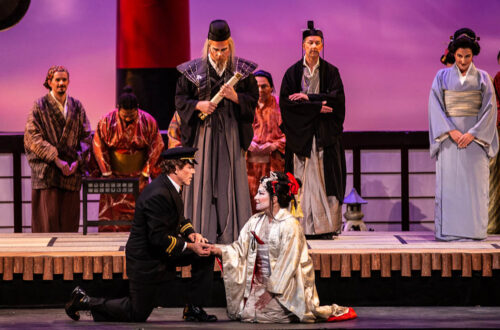
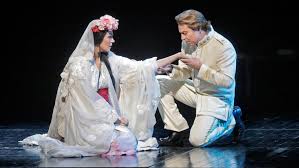
In “The Spectacle of the Other,” Stuart Hall discusses how representations of non-Western cultures often rely on stereotypes, emphasizing a binary set of “the exotic Other” against the “familiar West.” In Puccini’s Madama Butterfly, this binary becomes vivid in the opening scene, where Lieutenant Pinkerton, a U.S. naval officer, meets Cio Cio San, a young Japanese girl he is set to marry temporarily. The opera uses music, dialogue, and costumes to portray Cio Cio San as submissive, naive, and mystical– all qualities often stereotypically assigned to Asian women in Orientalist frameworks. Her delicate voice, traditional attire, and ritualized movements are all made to appeal to Western ideas of the “exotic”…
-
Astan Diarra Discussion Post 5
In the “Flower Duet” scene where Cio-Cio-San is waiting for her husband to come home and she says “I shall stand there on the brow of the hill and wait, and wait a long time, and I shan’t find the long wait wearisome.” This highlights how naive Cio-Cio-San is because the audience and the other characters know that Pinkerton will not come back but she still has some faith that the marriage she is in will be fruitful. This characterizes Japanese people as people who during this time are unaware of what reality is truly like and people who are over optimistic. This also makes it seem people from the…
-
Chelsea Tanchez – Discussion Post 5
Stuart Hall’s essay “The Spectacle of the Other” explains the idea of how people create specific stereotypes through visual representation. Minorities are usually classified as the ‘other’, who are different from the dominant norm in the society. Edward Said’s concept of Orientalism explains how the “Occident’ (western society) creates stereotypes of the “Orient” (Eastern cultures) to justify their dominance and colonialism. With this idea, the opera Madama Butterfly displays orientalism by having the American naval officer see Cio-Cio San as exotic and merely a tool for his pleasure. The butterfly appears with her family in a traditional Japanese wedding ceremony in the first scene. Pinkerton’s seems casual about the whole thing.…
-
Shimon Jeselsohn discussion post 5
Puccini’s opera Madama Butterfly portrays the Orient as far less superior and the Occident as highly dominant and superior through the portrayal of the characters. This aligns With Stuart Halls’s idea about the “other” in this case being the East and Butterfly. Through the character of the Butterfly, the opera can portray the West as dominant and the East as just being a silly submissive love culture. A specific scene that points to this is the wedding between Pinkerton and Butterfly. Pinkerton is casual and seems as if the wedding is not really a big deal but Butterfly seems as if this wedding is super important and significant. This plays…
-
Jigna Oza- Opera
Stuart Hall’s essay “The Spectacle of the Other” discusses how the media/ art can be often used to reinforce stereotypes of a certain group. This is something that I’ve noticed countless times growing up and watching a lot of shows. For example, I am Indian and have seen Indians being portrayed in Hollywood with strong accents and often having strict parents. For Madama Butterfly, the performance also in some ways reinforced the exoticism of women of color. The main character Cio-Cio-San is a young girl who is East Asian, willing to get married to live a better life. Her character alone already plays into stereotypes surrounding women of color being…
-
Bosco Wong’s Discussion Post #5
In “Un bel dì vedremo” [Act II], Butterfly sings with unwavering faith that Pinkerton will return to her, reaching toward the distant horizon as if already watching him come back. She does not question why he left or the pain it caused; she simply waits, filled with pure devotion. Under Stuart Hall’s “The Spectacle of the Other,” this is not just about love; her identity is entirely wrapped up in this singular hope. She is shaped to fulfill a Western fantasy of the East—a figure of endless patience and tragedy, waiting for a man who barely thinks of her. Thus, her faith feels almost unreal, embodying the ultimate “Other”: a…
You May Also Like

Jayden Pooran’s Discussion Post 1
-
Discussion Post #5
-
Kevin Joseph’s Discussion Post #5